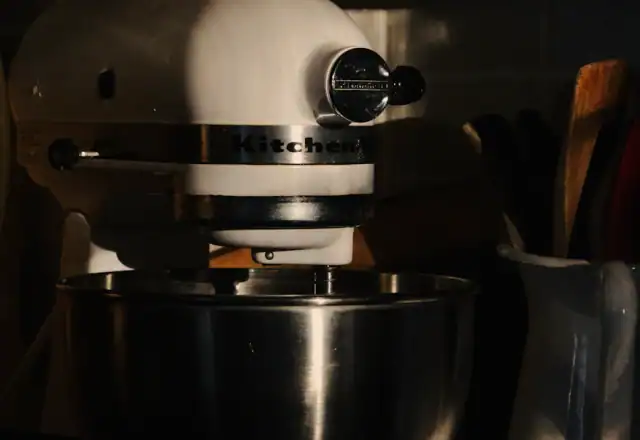
Equipment and facilities
Commercial Kitchen Equipment and Facilities
A practical checklist of the equipment, storage and support facilities that matter when you rent, and the questions to ask about each.
Free to inquire. We reply by email, usually within one business day.
A rental commercial kitchen should provide a cooking line with ventilation, ovens, stainless prep stations, handwashing and three-compartment sinks, commercial dishwashing, dry, refrigerated and freezer storage, and secure access with loading. Confirm capacities, models and availability in writing, because equipment varies between kitchens.
Why equipment details matter
Two kitchens with the same hourly rate can be very different places to work. The right equipment determines whether your recipes scale, how long production takes and whether you can pass an inspection without improvising. Before you rent, match your recipes to the equipment list line by line and confirm that each item is available during your booked hours.
Equipment listings should always include capacity, not just names. A convection oven with a single tray rack is not the same as a double-stack unit that holds twelve full sheet pans. Ask for dimensions, power type (gas or electric) and any training or sign-off required before use.
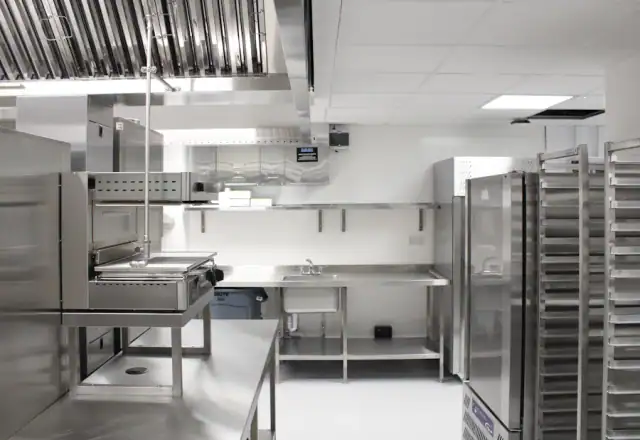
Cooking line and ventilation
The cooking line is the heart of the kitchen. It typically includes gas or electric ranges, a flat-top griddle, char grills and deep fryers, all beneath a Type I range hood with fire suppression. The hood determines what you are allowed to cook: grease-producing cooking must sit under a rated hood.
Check how many burners and fryer baskets you can use at once in a shared setting, and whether stock pots, tilt skillets or steam kettles are available for larger batches. See cooking line, grills and fryers for what to ask.
Matching equipment to your product
Different food categories lean on different equipment. Baked goods depend on oven capacity, proofing space and mixers. Sauces and soups depend on kettles, burners and cooling capacity. Meal prep depends on prep tables, portioning scales and chilled storage. Delivery brands depend on a fast cooking line and tidy packing space. Catering depends on holding equipment and a loading area close to the door.
Write down the three pieces of equipment your product cannot be made without, and confirm each is available at the times you plan to cook. Then list the nice-to-have items. If the essentials are present and the extras are not, you can often work around the gaps with small purchases of your own. If an essential is missing, move on to a different kitchen rather than redesigning your product around the space.
Ovens and baking equipment
Bakers and any business that roasts in volume should look at oven type, number of racks, tray dimensions and whether proofing cabinets, cooling racks and dough sheeters are on site. Convection ovens speed up most baked goods, deck ovens suit breads and pizza, and combi ovens add steam for precise results.
Our page on ovens and baking equipment explains tray sizes, temperature recovery and usage restrictions, and the bakery kitchen page covers workflow for bakers.
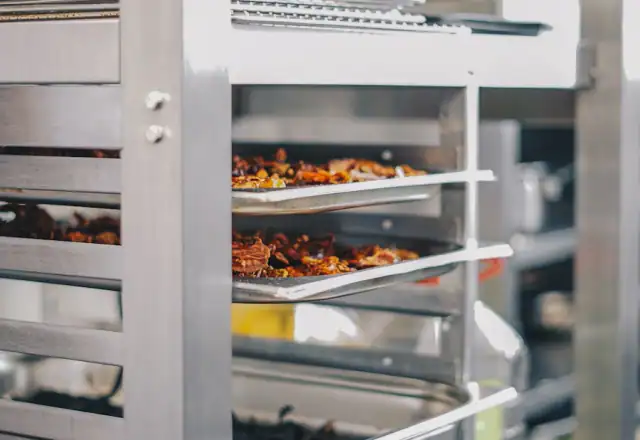
Prep stations, mixers and small equipment
Prep space is where most time is spent. Look for stainless steel work surfaces that are easy to sanitize, adequate counter length per person in shared setups, and nearby sinks for handwashing. Planetary stand mixers, food processors, slicers and scales are common but should be confirmed.
Small wares such as sheet pans, hotel pans, cutting boards and utensils are sometimes provided and sometimes not. Ask, and plan to bring your own knives and any item you use daily. See mixers and dough equipment and preparation workstations.
Storage: dry, chilled and frozen
Storage often decides whether a kitchen can support your business. Dry storage holds ingredients and packaging off the floor, refrigerated storage keeps cold items at or below 41°F, and freezer storage holds frozen items at 0°F. Ask whether space is shelf-based, bin-based or lockable, how it is monitored and whether access is limited to your team.
Labeling matters in shared storage. Every item should carry a name, date and allergen information so it can be identified and rotated safely, and the kitchen should explain how it prevents cross-contamination between tenants.
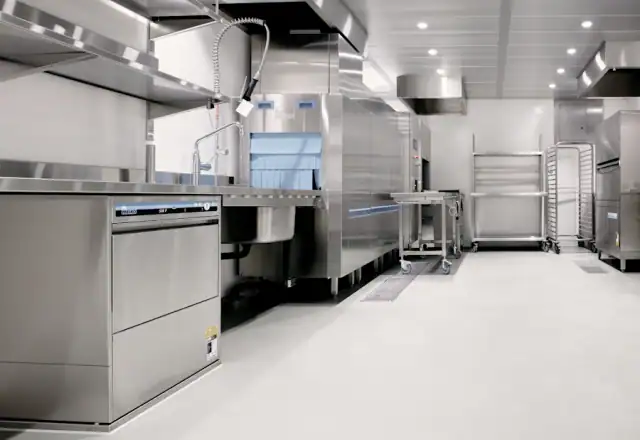
Wash-up, waste and sanitation
A commercial dishwasher, a three-compartment sink, a pot-wash area and a separate handwashing sink are standard. Confirm the sanitizer type and test strips, who supplies cleaning chemicals and where grease, food waste and recycling are handled. The dishwashing facilities page explains what tenants are responsible for.
Clear cleaning expectations protect everyone. The kitchen rules and hygiene page sets out the standard we expect at the end of every session.
An equipment checklist you can take on a tour
- Which cooking equipment is available during my booked hours?
- What are the capacities, tray sizes and power types?
- Is training or sign-off required before I use any item?
- How much dry, chilled and frozen storage can I have, and how is it secured?
- Who supplies sanitizer, towels, sheet pans and small wares?
- How are waste, grease and recycling handled?
- Where do deliveries arrive and how long can vehicles stay?
Bring this list to your kitchen tour and mark each answer. If a feature you need is missing, ask about alternatives or a different rental format.
Loading, security and staff facilities
Support facilities shape daily convenience. Look for loading and delivery access, nearby parking, secure access control and staff and changing facilities such as lockers, restrooms and a break area. Food truck owners should also ask about parking and support services.
If you need a place to handle paperwork, some operators offer a business workspace with desks and Wi-Fi. These are small features that save real time.
More on commercial kitchen rental
This page is part of our commercial kitchen rental guide. Follow the pathways below to move up to the overview, compare alongside topics or go deeper into the detail.
Start with the overview
- Commercial Kitchen RentalEverything you need to choose between shared, private, hourly, ghost and production…
- Pricing and Rental PlansA clear explanation of what you pay for, what changes the price and how to get a quote…
- Kitchen Rental States and AreasBrowse every state and its areas, learn how local rules shape your options and request help…
Compare alongside
- How Renting WorksSix clear steps from first inquiry to your first confirmed session, with what to prepare…
- Pricing and Rental PlansA clear explanation of what you pay for, what changes the price and how to get a quote…
- Rental RequirementsA plain checklist of what you need before you rent, why each item matters and how to check…
- Commercial Kitchen RentalEverything you need to choose between shared, private, hourly, ghost and production…
Go deeper
- Cooking Line, Grills and FryersBurners, griddles, grills and fryers decide what you can cook and how fast. Here is how to…
- Ovens and Baking EquipmentA baker’s guide to ovens and baking equipment in a rented kitchen: oven types, tray sizes…
- Refrigerated StorageHow chilled storage works in a rented kitchen: capacity, allocation, temperature…
- Book a Kitchen TourSee the equipment, test your workflow and ask the questions that matter. Tours are free…
Frequently asked questions
Straight answers to the questions food businesses ask most about equipment and facilities.
What equipment is included in a commercial kitchen rental?
Most include a cooking line with a hood, ovens, stainless prep tables, sinks and dishwashing. Storage, specialty equipment and small wares vary, so ask for a written list.
Can I bring my own equipment?
Often yes for small, plug-in items, subject to the operator approving it for safety and electrical load. Large equipment usually needs written approval.
Do I need training to use the equipment?
Many kitchens require a short induction and sign-off on larger or higher-risk equipment such as mixers, slicers and fryers.
Is storage included?
Storage is commonly priced separately by shelf, bin or footprint. Confirm what is included in your base rate.
Are cleaning supplies provided?
Sanitizer and basic cleaning supplies are often provided, while specialty chemicals and your own consumables are yours to bring. Confirm this at your tour.
How do I know the equipment is in good condition?
Ask about maintenance schedules and see the equipment in action at your tour. A well-run kitchen can tell you when each item was last serviced.
Ask about this kitchen option
Tell us what you need and we reply by email, usually within one business day, with a clear next step.