Rental options
Central Production Kitchen Rental
Bulk production space with the throughput, cooling and storage to support volume cooking and regular distribution.
Free to inquire. We reply by email, usually within one business day.
A central production kitchen is a large-format commercial kitchen designed for cooking food in volume, then storing, packing and distributing it. Businesses rent space with large equipment, cooling capacity and loading access to supply restaurants, caterers, retailers and delivery brands. It suits repeatable batch production rather than made-to-order cooking.
What a central production kitchen is
A central production kitchen, sometimes called a commissary or central kitchen, prepares food in bulk for use elsewhere. Restaurants use them to consolidate prep across several sites, caterers use them to prepare large events and meal prep or packaged food brands use them to produce stock for sale. The layout favors flow, with receiving, prep, cooking, cooling, packing and dispatch arranged to move product efficiently.
Compared with a shared kitchen, production space offers larger equipment, more storage and often better loading access. It is built for repeatable output, which suits businesses that already know what they make and need to make more of it, reliably.
Equipment built for volume
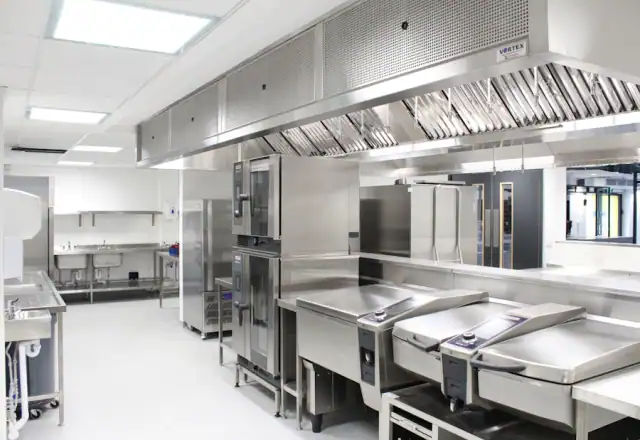
Production kitchens usually offer equipment that scales batch size: steam kettles, tilt skillets, large mixers, combi or rack ovens, blast chillers and large walk-in coolers. Equipment is chosen for throughput, repeatability and food safety rather than for a flexible à-la-carte menu.
- Steam kettles and tilt skillets for sauces, soups and stews
- Rack or combi ovens for large batches of baked or roasted food
- Blast chillers or large cooling capacity for safe cooling
- Large mixers, slicers and food processors
- Walk-in refrigeration and freezers
- Packing tables, scales and labeling equipment
Confirm capacities and cycle times, because they determine how much you can actually make in a shift.
Quality control and consistency at volume
Volume production lives or dies on consistency. Standardize every recipe in weights and measures, document each step with times and temperatures and train every person who works on it. Taste and test a sample from each batch, and record results so you can spot drift before customers do.
Batch coding and traceability are essential at scale. Label every container with the product, date and batch code, and keep records of ingredients and suppliers. If an issue arises, you can quickly identify affected product. Our guide to batch coding and product traceability walks through a simple system.
Cooling, storage and cold chain
Safe cooling is the most common bottleneck in volume production. Cooked food must move from 135°F to 70°F within two hours and to 41°F within a further four hours. Blast chillers and ice baths make this possible; ordinary refrigerators do not. Ask how much cooling capacity you can use and when.
Storage and the cold chain also matter. You may need chilled and frozen space for finished product awaiting pickup, plus dry storage for ingredients and packaging. See the pages on refrigerated storage, freezer storage and dry storage.
What to ask about a production kitchen before you commit
- What are the real capacities of kettles, ovens and chillers, and how many can I use at once?
- How much cooling and cold storage can I reserve?
- What are the loading hours and vehicle access limits?
- Are utilities metered, and how are heavy-use charges calculated?
- Who maintains equipment, and how quickly are faults repaired?
- How do you manage cleaning and allergens between tenants?
- Can I add capacity or storage as I grow?
Bring these questions on your tour and ask to see the equipment in use, not just standing idle.
Throughput planning
Throughput is how much finished product you can produce per hour. It depends on equipment size, batch time, labor and the slowest step in your process. Map your recipe from receiving to dispatch, time each step and find the bottleneck. A recipe that cooks in forty minutes but cools in four hours is limited by cooling, not cooking.
Our guides on planning a batch production schedule and designing a preparation workflow walk through how to do this. Use the results to decide how many hours and how much equipment you need.
Loading, delivery and distribution
If you supply other sites, loading access is as important as the oven. Ask about dock height, vehicle access, pickup windows and whether refrigerated vans can park while loading. Receiving ingredients also needs space for pallets, a place to check temperature on arrival and a clear process for rejecting out-of-spec deliveries.
The loading and deliveries page explains what to check. A kitchen with poor access slows every day of production, so treat it as a core requirement rather than a bonus.

Costs and commitments
Production space is typically priced by monthly rent, by dedicated hours or by a mix of time and square footage, with storage added. Because the equipment is large, and utilities consumption is heavy, some operators meter gas, water and electricity. Contracts tend to be longer than for shared kitchens, with deposits to match.
Use the pricing page to understand drivers and request a quote that reflects your batch sizes and cooling needs. If you are scaling from a shared kitchen, our scaling guide can help you decide when the move makes sense.
Who production kitchens suit
- Caterers preparing for large events
- Meal prep and delivery brands with fixed weekly menus
- Restaurant groups consolidating prep
- Small food manufacturers producing for retail
- Sauce and condiment brands cooking in batches
- Community meal programs preparing food for large groups
If your production is smaller or irregular, a shared kitchen will usually cost less.
More on kitchen rental formats
This page is part of our kitchen rental formats guide. Follow the pathways below to move up to the overview, compare alongside topics or go deeper into the detail.
Start with the overview
- Commercial Kitchen RentalEverything you need to choose between shared, private, hourly, ghost and production…
- Pricing and Rental PlansA clear explanation of what you pay for, what changes the price and how to get a quote…
- How Renting WorksSix clear steps from first inquiry to your first confirmed session, with what to prepare…
Compare alongside
- Hourly Kitchen RentalBook professional kitchen time by the hour for trials, events and irregular production, and…
- Cloud, Dark and Ghost Kitchen RentalDelivery-first kitchen space with rider collection and dispatch support, for brands that…
- Short-Term Kitchen RentalFixed-date kitchen access for projects, trials, seasonal peaks and backup capacity, without…
- Private Kitchen RentalExclusive access to your own licensed kitchen unit, on your schedule, with your equipment…
Go deeper
- Kitchen Rental for Small Food ManufacturersRepeatable production, batch control and dispatch for growing food manufacturers who have…
- Catering Kitchen RentalEverything a catering business should check in a rented kitchen: batch capacity, holding…
- Planning a Batch Production ScheduleA written schedule turns a chaotic production day into a repeatable routine. Learn how to…
- Request a Rental QuoteTell us about your production and get a clear, written quote built around your hours…
Frequently asked questions
Straight answers to the questions food businesses ask most about central production kitchen rental.
What is the difference between a production kitchen and a shared kitchen?
A production kitchen is designed for bulk, repeatable output with larger equipment and storage. A shared kitchen is general-purpose space used by several businesses at scheduled times.
Do I need a blast chiller?
If you cook large batches of food that must be cooled safely, yes or equivalent cooling capacity. Ask what the kitchen offers.
Can I leave product in storage between runs?
Often yes, subject to labeling, time limits and allocated chilled or frozen space.
Is production kitchen rental only for large businesses?
No. Many small brands rent production space once their batch sizes outgrow a shared kitchen.
Do production kitchens have loading docks?
Many do. Ask about vehicle access, dock height and pickup windows for your suppliers and drivers.
How do I know how much capacity I need?
Map your recipe step by step, time each stage and find the bottleneck, then request a quote based on those figures.
Can I run multiple shifts in a production kitchen?
Often yes on private or dedicated plans. Confirm hours, staffing rules and utility charges.
Can I distribute directly from the kitchen?
Many production kitchens allow pickups and deliveries from the loading area, subject to rules and permits.
Do I need HACCP documentation?
Many wholesale buyers and some jurisdictions expect a food safety plan, often based on HACCP principles. Ask your local authority and buyers what they require.
Ask about this kitchen option
Tell us what you need and we reply by email, usually within one business day, with a clear next step.